What Causes Prostate Inflammation in Younger Men?

/images/what-causes-prostate-inflammation-in-younger-men-cover.webp
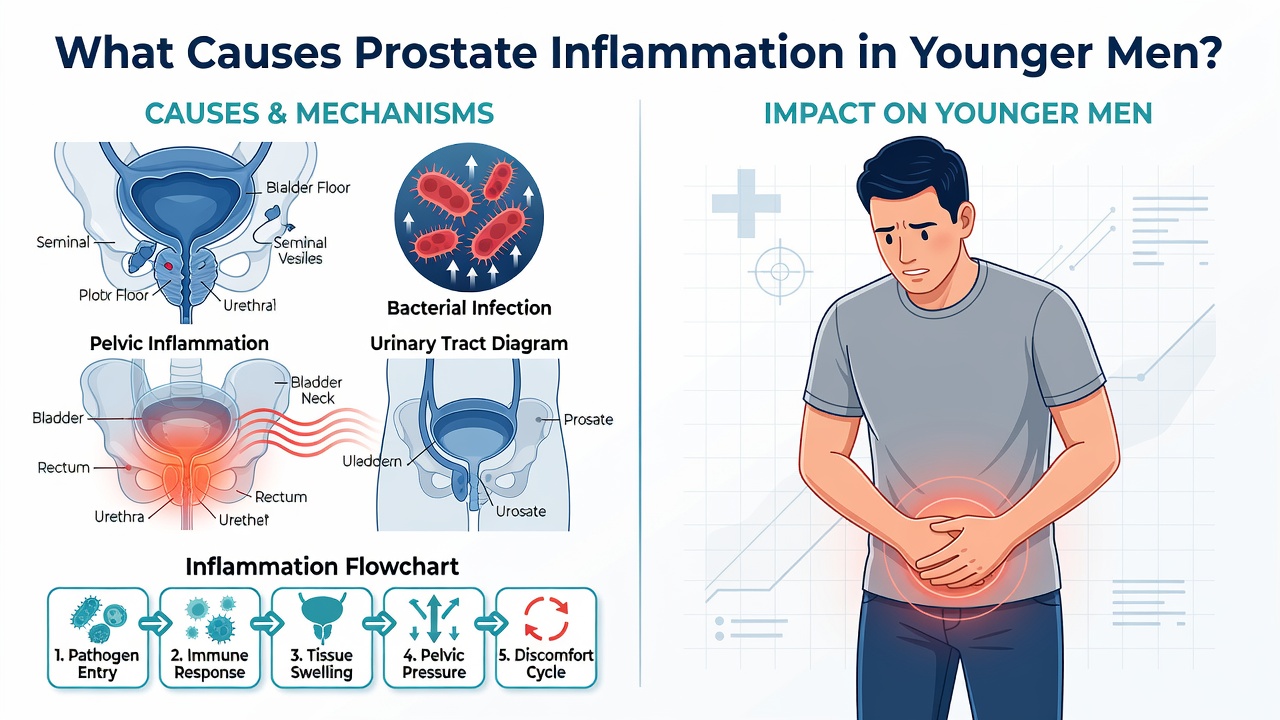
Prostate inflammation in younger men is most commonly caused by bacterial infection, non-bacterial pelvic floor dysfunction, urinary reflux, perineal trauma, and psychological stress — often in combination. Known clinically as prostatitis, this condition is the most common urological diagnosis in men under 50, affecting an estimated 5% of men aged 20 to 50 years and accounting for roughly two million healthcare visits annually in the United States alone.
Unlike prostate enlargement or prostate cancer, which are diseases of older men, prostatitis (often linked to hormonal health in men) predominantly strikes younger adults during their most productive years. According to the National Institute of Diabetes and Digestive and Kidney Diseases (NIDDK), prostatitis accounts for approximately 8% of all urology outpatient visits and 1% of all primary care visits by men — a burden that is frequently underappreciated by both patients and clinicians.
The condition is not a single disease but a syndrome with four recognised clinical subtypes, each with a distinct cause, course, and treatment strategy. Understanding what drives prostate inflammation in younger men — and considering supportive options like Primordial Vigor X for overall men's vitality — requires examining bacterial pathogens, immune dysregulation, pelvic anatomy, lifestyle triggers, and the complex interplay between neurological and psychological factors. This article breaks down the evidence-based causes in clinical detail.
What Causes Prostate Inflammation in Younger Men? The Four Clinical Types
The National Institutes of Health classifies prostatitis into four distinct syndromes, and understanding these categories is essential for identifying the correct cause in any individual case. The four types are: Type I (acute bacterial prostatitis), Type II (chronic bacterial prostatitis), Type III (chronic prostatitis/chronic pelvic pain syndrome, or CP/CPPS), and Type IV (asymptomatic inflammatory prostatitis). Each category reflects a different underlying mechanism of prostate inflammation.
According to a landmark prospective cohort study by Propert et al. (2006, PMID: 16407009) conducted through the National Institutes of Health, men with chronic prostatitis experience significant reductions in quality of life comparable to those seen in conditions such as congestive heart failure, angina, and Crohn's disease — underscoring the serious clinical weight this condition carries.
Bacterial Infections: The Identifiable Cause in a Minority of Cases
Bacterial prostatitis — encompassing Types I and II — is caused by pathogenic microorganisms ascending from the urethra or descending from the bladder into prostatic tissue. The most frequently isolated organism is Escherichia coli, which is responsible for approximately 50% to 90% of confirmed bacterial prostatitis cases. Other members of the Enterobacteriaceae family, including Klebsiella pneumoniae and Proteus mirabilis, are also implicated.
Crucially, the organisms responsible are predominantly gut-origin commensals rather than sexually transmitted pathogens, though Chlamydia trachomatis and Neisseria gonorrhoeae can occasionally cause prostatitis in younger sexually active men. This distinction matters for antibiotic selection and for guiding appropriate screening in at-risk populations.
A particularly notable finding from microbiological research involves Propionibacterium acnes, an organism more commonly associated with acne vulgaris. Studies have identified it as the most prevalent microorganism isolated from prostatic tissue overall, and evidence suggests it contributes meaningfully to the development of prostate inflammation and, potentially, to downstream prostate diseases including benign prostatic hyperplasia and prostate cancer. The mechanism is thought to involve chronic low-grade immune activation within prostatic tissue.
Confirmed risk factors for bacterial prostatitis include a history of urinary tract infection, incomplete bladder emptying, recurrent urethral infections, recent urological procedures, and structural abnormalities of the lower urinary tract. According to the NIDDK, nerve damage in the lower urinary tract is also a significant predisposing factor for all forms of prostatitis.
Chronic Pelvic Pain Syndrome: Why Most Cases Have No Detectable Infection
CP/CPPS (NIH Type III) accounts for the overwhelming majority of prostatitis diagnoses in younger men, yet its pathogenesis remains incompletely understood and clinically challenging. By definition, CP/CPPS involves chronic pelvic pain lasting at least three to six months with signs of prostate inflammation — but without any detectable bacterial infection confirmed by standard urine or prostatic secretion cultures.
"The etiology and pathogenesis of chronic prostatitis/CPPS likely involves a pluricausal, multifactorial mechanism. Perineal and/or pelvic trauma, infection, reflux of toxic or immunogenic urine material, and/or psychological stress can trigger a cascade of incidents, leading to local inflammation and/or neurogenic damage."
— Breser ML et al., Frontiers in Immunology, 2017 (PMC5535188)
The current scientific consensus, supported by StatPearls clinical guidelines (PMID: 38261706), identifies CP/CPPS as a condition driven by immune dysregulation, neuroinflammation, and peripheral and central sensitisation — rather than any single identifiable pathogen. Activated mast cells, elevated pro-inflammatory cytokines (including interleukin-1β, interleukin-6, and tumour necrosis factor-alpha), and autoimmune T-cell responses targeting prostatic antigens have all been documented in tissue and fluid samples from affected men.
Urinary reflux — the backflow of urine into prostatic ducts during voiding — is considered a particularly important initiating mechanism. Urine contains immunogenic and potentially toxic materials, including uric acid crystals and bacterial fragments, that can trigger a sterile inflammatory response within prostatic tissue even in the complete absence of live bacterial organisms. This explains why CP/CPPS can develop without any identifiable infection and why it frequently resists antibiotic treatment.
Physical and Lifestyle Triggers That Promote Prostate Inflammation
Beyond infection and immune dysregulation, a range of physical and lifestyle factors are recognised as precipitating or aggravating prostate inflammation in younger men. These triggers are particularly relevant for CP/CPPS, where mechanical and neurological insults to the pelvic floor play a central role.
Perineal and pelvic trauma — whether from a single incident such as a cycling accident or from repetitive microtrauma — can initiate a cascade of neurogenic inflammation within the prostate and surrounding pelvic structures. The pudendal nerve and its branches are particularly vulnerable to compression from prolonged sitting or pressure from bicycle saddles, and irritation of these nerves can produce pain that is clinically indistinguishable from prostate-origin pain.
Research has also identified pelvic floor muscle dysfunction as a driver of CP/CPPS symptoms. Chronic hypertonic (over-tightened) pelvic floor muscles create a sustained mechanical compression of pelvic nerves and vessels, producing a self-perpetuating cycle of pain and inflammation. This is why physical therapy targeting the pelvic floor has emerged as an evidence-supported treatment modality for younger men with this condition.
The Role of Psychological Stress and Neurological Sensitisation
The connection between psychological stress and prostate inflammation is not merely anecdotal — it is mechanistically grounded in the neurobiology of the stress-immune axis. Psychological stress activates the hypothalamic-pituitary-adrenal (HPA) axis and the sympathetic nervous system, promoting the release of corticotropin-releasing hormone (CRH) and catecholamines. These neuroendocrine signals can directly modulate mast cell activity and cytokine production within pelvic tissues, creating the conditions for sterile neurogenic inflammation.
The NIDDK explicitly identifies emotional stress as a risk factor for chronic prostatitis. Studies of men with CP/CPPS consistently demonstrate elevated rates of anxiety, depression, and catastrophising — though researchers have debated whether these psychological states are a cause or consequence of chronic pain. Current evidence, reviewed comprehensively in StatPearls (PMID: 38261706), suggests a bidirectional relationship: psychological distress lowers the pain threshold through central sensitisation, while chronic pelvic pain increases psychological burden, amplifying inflammation through ongoing stress-pathway activation.
Central sensitisation — a neuroplastic process in which the central nervous system becomes hypersensitised to pain signals — is now considered a defining feature of advanced CP/CPPS. In this state, normal physiological stimuli in the pelvic region are interpreted by the brain as painful, and the inflammatory response becomes self-sustaining even in the absence of ongoing peripheral tissue damage. This explains the frequent disconnect between objective findings on prostate examination and the severity of symptoms reported by affected men.
Key Takeaway
Psychological stress does not merely worsen prostate inflammation — it can actively initiate and perpetuate it through measurable neuroimmunological mechanisms involving mast cell activation, cytokine release, and central pain sensitisation.
How Prostate Inflammation Affects Sexual Health in Younger Men
The sexual health consequences of prostate inflammation in younger men are substantial and frequently underreported. In clinical studies of CP/CPPS populations, 34% of patients exhibit erectile dysfunction and 55% report ejaculatory dysfunction — rates that are significantly elevated compared with age-matched controls without prostate inflammation. Premature ejaculation, reduced libido, painful orgasm, and semen abnormalities are also disproportionately prevalent in men under 50 with prostatitis.
The mechanisms underlying sexual dysfunction in this context are multifactorial. Inflammation within the prostate and seminal vesicles disrupts the normal secretory function of these glands, altering semen volume, pH, viscosity, and sperm motility. Pro-inflammatory cytokines — particularly interleukin-6 and tumour necrosis factor-alpha — have been detected in elevated concentrations in the ejaculates of men with CP/CPPS and are directly cytotoxic to spermatozoa. This has implications not only for sexual satisfaction but also for male fertility, as confirmed by research published via PMC10455764, which links chronic prostatitis to measurable impairment of sperm parameters and male reproductive potential.
Pain during or after ejaculation — a hallmark symptom of prostate inflammation — is itself a significant contributor to reduced sexual activity and relationship strain in affected younger men. This pain arises from spasm of the inflamed prostatic smooth muscle and perineal musculature during orgasm, compounding the psychological burden of the condition and reinforcing the stress-inflammation cycle described above.
Recognising Symptoms: What Prostate Inflammation Feels Like in Younger Men
Prostatitis presents with a variable and often overlapping constellation of symptoms that can confound diagnosis, particularly in younger men who may not associate pelvic discomfort with their prostate. Clinicians at the NIH note that symptom profiles differ substantially between individuals, and no single symptom is pathognomonic for any one type of prostatitis.
Common symptoms of prostate inflammation in younger men include painful or burning urination (dysuria), a sensation of incomplete bladder emptying, urinary urgency and frequency, lower back pain, burning or discomfort in the penis, pain in the perineum (the area between the scrotum and rectum), lower abdominal and suprapubic pain, pain or discomfort with ejaculation, and — in acute bacterial cases — systemic symptoms such as fever, chills, and malaise. In CP/CPPS, these symptoms persist for at least three months and fluctuate in severity over time.
Diagnosis typically involves a detailed symptom history using validated tools such as the NIH Chronic Prostatitis Symptom Index (NIH-CPSI), urine culture, expressed prostatic secretion analysis, and in some cases, urodynamic studies or pelvic floor assessment. Imaging is generally reserved for cases where complications such as prostatic abscess are suspected. Younger men experiencing any combination of the above symptoms for more than a few weeks are encouraged to seek evaluation from a urologist rather than attributing symptoms to a minor infection that will resolve spontaneously.
Frequently Asked Questions
Scientific References
Editorial Information
Sarah Mitchell writes educational content covering health, nutrition, and wellness topics. Her work is intended to present information in a clear and accessible format while encouraging readers to consult qualified healthcare professionals for personal medical advice.