Testosterone Deficiency and Muscle Loss in Men

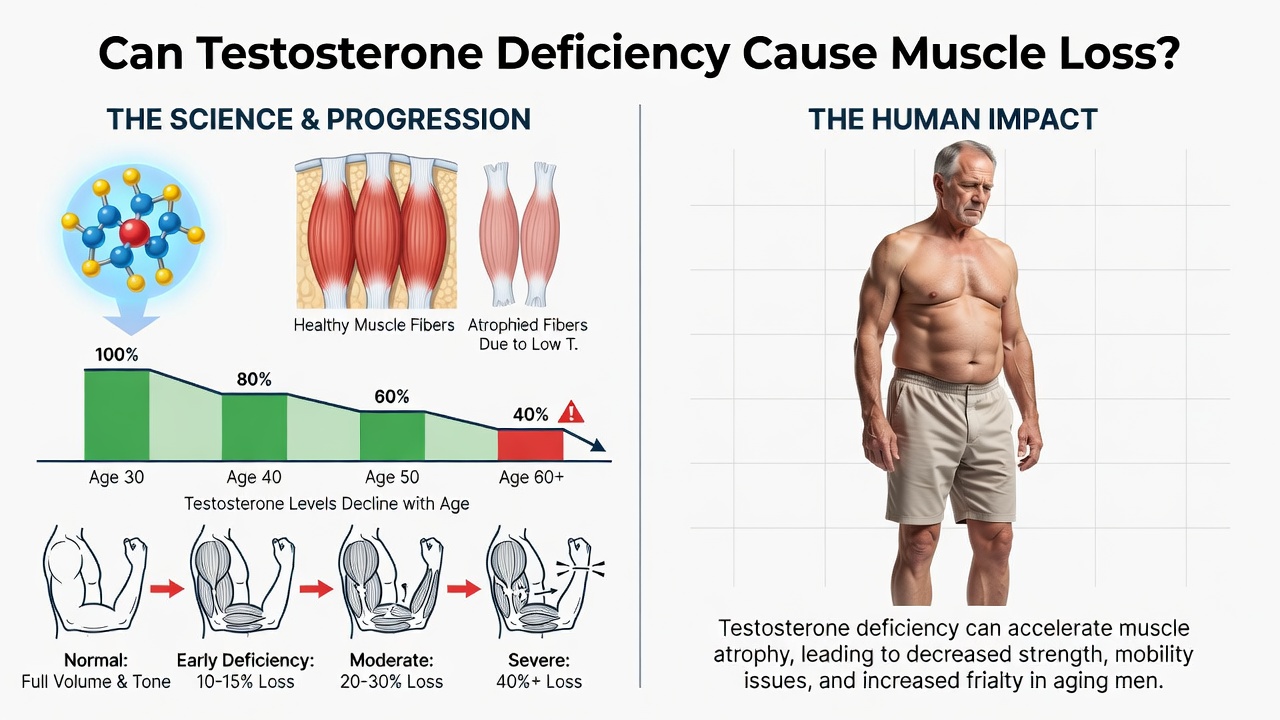
Yes — testosterone deficiency can directly cause muscle loss in men. Testosterone is the primary anabolic hormone responsible for building and maintaining skeletal muscle tissue. When levels fall below normal, the body loses its ability to synthesise muscle protein efficiently, accelerating the breakdown of lean mass. This process, known clinically as sarcopenia when it becomes significant, affects millions of men with low testosterone and worsens progressively without intervention.
Understanding exactly how testosterone supports muscle, why deficiency accelerates loss, and what evidence-based options exist — including supplements like Primordial Vigor X — is essential for any man concerned about strength, physical function, and long-term health. This article examines the clinical science behind testosterone's role in muscle maintenance and what men can realistically do about it.
How Testosterone Builds and Maintains Muscle
Testosterone exerts its anabolic effects primarily by binding to androgen receptors located within muscle cells. Once bound, it activates gene transcription pathways that increase the production of contractile proteins — chiefly actin and myosin — the structural components of muscle fibres. This process is called muscle protein synthesis (MPS), and testosterone is one of its most powerful regulators in men.
Beyond direct stimulation, testosterone also promotes the release of insulin-like growth factor 1 (IGF-1) from the liver and within muscle tissue itself. IGF-1 activates satellite cells — the muscle stem cells responsible for repair and growth following exercise. Research published in the study by Bhasin et al. in the New England Journal of Medicine demonstrated a clear dose-dependent relationship between testosterone levels and both muscle volume and strength, confirming that higher physiological testosterone directly translates to greater lean mass.
Testosterone also opposes the action of cortisol and other catabolic hormones that break down muscle tissue. In healthy men, this anabolic-catabolic balance favours muscle maintenance. When testosterone declines, this protective counterweight is removed, and catabolism gains the upper hand.
What Happens to Muscle When Testosterone Drops
Testosterone deficiency — clinically defined as hypogonadism — occurs when serum total testosterone falls below approximately 300 ng/dL, though symptoms can appear at varying thresholds depending on the individual. The National Institutes of Health recognises hypogonadism as a significant health condition affecting an estimated 2–6% of men broadly, with prevalence rising sharply with age.
As testosterone falls, several muscle-related changes occur simultaneously. Muscle protein synthesis rates decline, meaning the body rebuilds muscle tissue more slowly after normal daily wear. At the same time, protein degradation continues at its usual pace or accelerates, creating a net negative protein balance — more muscle is being broken down than is being rebuilt.
This loss is not trivial. Studies show that men with confirmed hypogonadism have significantly lower appendicular lean mass (the muscle on the arms and legs) compared to age-matched men with normal testosterone. A landmark study by Bhasin et al. (2003) found that testosterone administration in older men with low baseline levels produced meaningful gains in lean mass and strength, confirming that the deficiency itself — not merely ageing — was driving the loss.
Muscle fibre composition also changes with testosterone deficiency. Type II fast-twitch muscle fibres, which are responsible for explosive strength and power, are particularly dependent on androgenic stimulation. Low testosterone preferentially shrinks these fibres, reducing both maximal strength and functional capacity — the kind that matters for everyday activities like climbing stairs or rising from a chair.
Age-Related Testosterone Decline and Sarcopenia
Men begin experiencing a gradual decline in testosterone production from around age 30, with levels falling approximately 1–2% per year. By the time a man reaches his 60s or 70s, cumulative reductions can be substantial. This age-related decline is a primary contributor to sarcopenia — the progressive loss of skeletal muscle mass and function that affects older adults.
Research published by Travison et al. (2007) in the Journal of Clinical Endocrinology & Metabolism tracked testosterone levels in men over time and confirmed a population-level secular decline in testosterone, separate from ageing effects, suggesting environmental and lifestyle factors compound the biological trend.
Sarcopenia associated with low testosterone is particularly concerning because muscle loss is strongly linked to increased fall risk, fractures, metabolic dysfunction, insulin resistance, and reduced quality of life. Men with low testosterone and coexisting sarcopenia represent a high-risk group that benefits most from comprehensive evaluation and management.
Diagnosis: Testing Testosterone Levels
Confirming testosterone deficiency requires a blood test measuring serum total testosterone, ideally taken in the morning when levels peak. A single low result should be repeated on a separate occasion to account for natural daily fluctuation. Clinicians typically also measure free testosterone (the biologically active fraction), luteinising hormone (LH), and follicle-stimulating hormone (FSH) to distinguish between primary hypogonadism (testicular failure) and secondary hypogonadism (pituitary or hypothalamic dysfunction).
Normal total testosterone ranges are generally considered 300–1000 ng/dL, though laboratories and clinical guidelines vary slightly. Symptoms must be interpreted alongside laboratory values — a man with values in the low-normal range but significant symptoms may still benefit from evaluation by an endocrinologist or urologist with expertise in male hormone health.
Treatment Options to Restore Testosterone and Rebuild Muscle
For men with confirmed hypogonadism, testosterone replacement therapy (TRT) is the most direct treatment. TRT is available in several forms including transdermal gels, intramuscular injections, subcutaneous pellets, and adhesive patches. Clinical trials consistently demonstrate that TRT restores lean muscle mass, reduces fat mass, and improves physical function in hypogonadal men.
The Testosterone Trials — a series of coordinated placebo-controlled studies — found that men aged 65 and older with low testosterone who received TRT for one year showed significant improvements in lean mass and walking distance compared to placebo, as reported by Snyder et al. (2016) in the New England Journal of Medicine. These findings underline that testosterone deficiency, not age alone, is a modifiable driver of muscle loss.
TRT is not appropriate for all men. Those with prostate health concerns, elevated haematocrit, severe sleep apnoea, or those wishing to preserve fertility require careful evaluation before initiation. The decision to use TRT should always be made collaboratively with a qualified healthcare provider following thorough assessment of risks and benefits.
Lifestyle interventions are equally important and often underutilised. Resistance training remains the most potent non-pharmacological stimulus for muscle protein synthesis and can partially offset the effects of mild testosterone deficiency. Combined with adequate dietary protein intake (at least 1.6 g per kilogram of body weight per day), exercise supports lean mass retention even as hormonal changes occur.
Optimising sleep, reducing chronic stress (which elevates cortisol, suppresses testosterone, and contributes to brain fog and fatigue), limiting alcohol, maintaining a healthy body weight, and addressing vitamin D deficiency are all evidence-supported strategies to support natural testosterone production and muscle health. A study by Pilz et al. (2011) demonstrated that vitamin D supplementation significantly raised testosterone levels in deficient men, highlighting the importance of micronutrient status in hormonal health.
Key Takeaways
Testosterone deficiency is a clinically established cause of muscle loss in men. The mechanisms are well understood — reduced protein synthesis, loss of satellite cell activation, and an imbalance between anabolic and catabolic forces. Men experiencing unexplained muscle loss, declining strength, or changes in body composition should consider testosterone testing as part of a thorough clinical evaluation. Both medical and lifestyle interventions can meaningfully reverse testosterone-related muscle decline when implemented appropriately and under professional guidance.
Frequently Asked Questions
Scientific References
Editorial Information
Sarah Mitchell writes educational content covering health, nutrition, and wellness topics. Her work is intended to present information in a clear and accessible format while encouraging readers to consult qualified healthcare professionals for personal medical advice.