Joint Pain Without Inflammation: Causes & Solutions

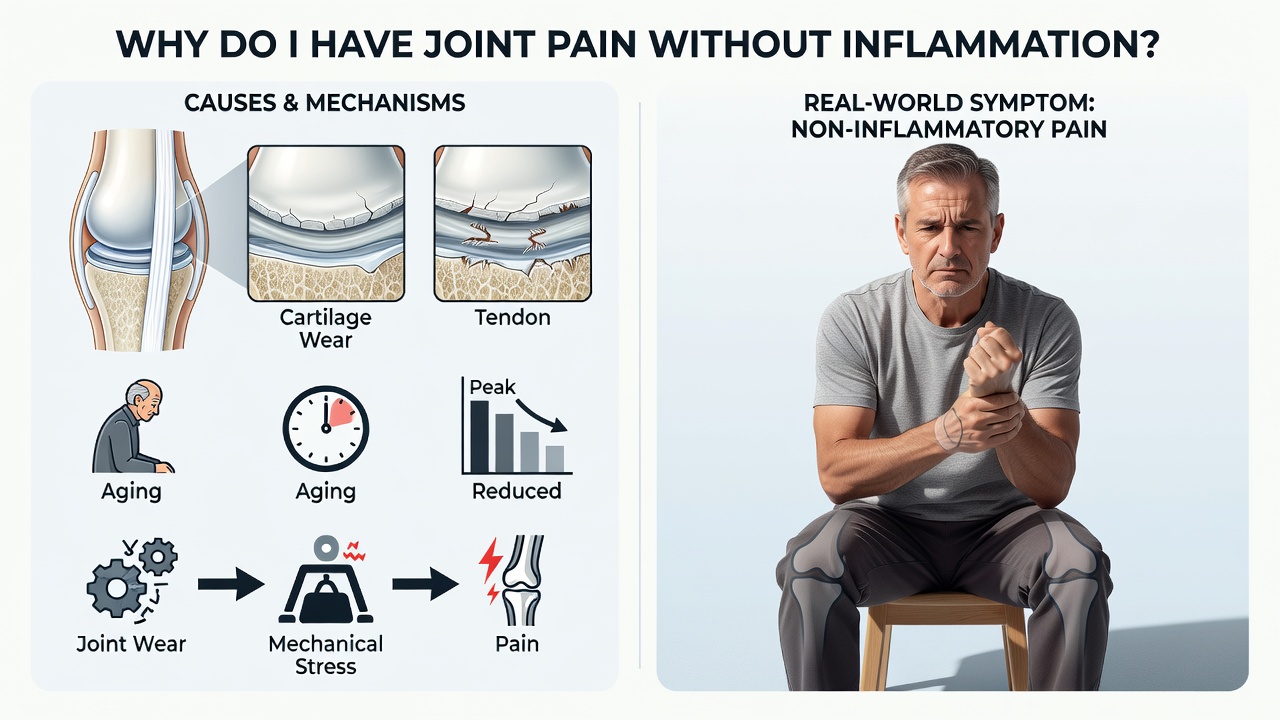
You wake up with aching knees. Your shoulders feel stiff during your morning workout. Yet when you visit your doctor, blood tests show no elevated inflammatory markers, and imaging appears normal. This disconnect—joint pain without measurable inflammation—affects millions of people and challenges the conventional understanding that pain equals inflammation.
The presence of joint pain without clinical or laboratory signs of inflammation is more common than many realize. While inflammatory conditions like rheumatoid arthritis dominate discussions about joint pain, numerous noninflammatory mechanisms can produce genuine, persistent discomfort. Understanding these pathways is essential for accurate diagnosis and effective treatment.
Mechanical Joint Pain Without Inflammation
Mechanical joint pain arises from structural wear, misalignment, or overuse rather than immune-driven inflammation. Osteoarthritis, despite its prevalence, does not always present with elevated inflammatory markers. Early-stage cartilage degradation produces pain signals through mechanoreceptors and nociceptors in joint tissues without triggering systemic inflammation.
Repetitive strain injuries exemplify this pattern. Weekend athletes and desk workers commonly experience joint discomfort from overuse—the mechanical stress damages tissues faster than inflammatory repair mechanisms activate. Muscle imbalances, poor posture, and biomechanical inefficiencies shift load distribution across joints, creating localized pain without systemic inflammatory response.
Joint hypermobility and ligamentous laxity represent another mechanical category. People with connective tissue disorders or excessive flexibility experience pain from micro-instability and proprioceptive disruption, not inflammation. The joint moves beyond its optimal range, triggering pain as a protective mechanism.
Neurological and Neuropathic Contributions
Central and peripheral nervous system dysfunction can generate joint pain independently of inflammation. Neuropathic pain involves sensitization of nerve fibers—both peripheral nerves and spinal cord neurons—that amplify pain signals disproportionate to actual tissue damage.
Peripheral sensitization occurs when nociceptors in joint tissues become hyperexcitable through repeated stimulation or mechanical stress. Small-fiber neuropathy, even subclinical forms, can produce diffuse joint and muscle discomfort without inflammatory biomarkers. Researchers have identified that pain perception involves complex neurochemical cascades beyond traditional inflammatory cytokines like IL-6 and TNF-α.
Central sensitization—heightened responsiveness of the central nervous system—can transform mild mechanical stress into severe pain. This mechanism underlies conditions like fibromyalgia, which produces widespread joint and muscle pain without objective inflammation. Abnormalities in pain neurotransmitters including substance P, serotonin, and norepinephrine contribute significantly to pain perception in these states.
Metabolic and Nutritional Deficiencies
Certain nutritional insufficiencies produce joint pain through metabolic mechanisms rather than inflammation. Vitamin D plays dual roles in bone mineralization and immune regulation; deficiency impairs both, leading to joint discomfort. Research examining the relationship between vitamin D deficiency and joint pain in adults demonstrates that adequate levels support cartilage health and pain modulation.
Magnesium deficiency affects muscle function, energy production, and pain sensitivity. Without adequate magnesium, muscles surrounding joints remain tense, increasing joint stress. Collagen-dependent conditions from vitamin C insufficiency weaken structural integrity of tendons, ligaments, and cartilage without necessarily triggering inflammation.
Metabolic acidosis, even mild chronic forms, creates an environment where joint cartilage deteriorates. Bone density decreases without inflammatory markers rising significantly. Individuals with poor diet quality, malabsorption syndromes, or restrictive eating patterns commonly develop joint pain from nutritional deficits.
Muscular Dysfunction and Deconditioning
Weak or imbalanced muscles are a primary driver of non-inflammatory joint pain. Muscles act as dynamic stabilizers; without adequate strength and endurance, joints absorb excessive force. This mechanical overload produces pain that persists despite normal inflammatory markers.
Sedentary behavior causes rapid muscular deconditioning. Within weeks of reduced activity, supporting muscles atrophy, forcing joints to compensate. The quadriceps muscles in the thigh, for instance, are critical stabilizers of the knee; weakness directly correlates with knee pain independent of cartilage damage or inflammation.
Poor movement patterns compound this issue. Individuals who habitually move inefficiently—climbing stairs with misaligned knees, reaching overhead with scapular dysfunction, walking with asymmetrical gait—gradually develop localized joint pain. Physical therapy addressing these patterns often resolves pain without anti-inflammatory medication.
Vascular and Connective Tissue Changes
Compromised blood flow to joints reduces nutrient delivery and waste removal. Avascular necrosis—bone death from inadequate blood supply—produces severe pain without significant inflammation initially. Similarly, reduced synovial fluid production from vascular insufficiency creates mechanical friction and pain.
Age-related changes in connective tissue quality occur gradually. Collagen crosslinking increases, making tissues stiffer and more prone to microtears. Elastin degrades, reducing tissue resilience. These structural changes generate pain through mechanical disruption rather than immune activation. Fascia surrounding muscles and joints can develop adhesions and restrictions that pinch nerve endings and produce localized pain.
Systemic Factors and Environmental Influences
Sleep deprivation impairs pain tolerance and increases joint discomfort perception. Chronic sleep debt lowers pain thresholds through neurochemical changes without inducing inflammation. Similarly, chronic stress elevates cortisol and activates the sympathetic nervous system, creating muscle tension and joint strain.
Hormonal fluctuations influence joint pain perception. Estrogen levels affect ligament laxity, water retention in joint tissues, and pain sensitivity. Women often report joint pain fluctuations corresponding to menstrual cycles despite stable inflammatory markers.
Environmental factors including temperature changes, barometric pressure variations, and humidity affect joint fluid viscosity and proprioceptive signaling. These factors produce genuine pain without inflammatory mechanisms. Repetitive microtrauma from occupational demands or sports activity can cause cumulative joint damage expressed as pain.
Diagnostic Approach to Non-Inflammatory Joint Pain
Accurate diagnosis requires comprehensive assessment beyond standard inflammatory markers. Clinical evaluation should include detailed pain characterization, movement pattern analysis, muscle strength testing, and functional assessment. Pain quality—sharp versus dull, localized versus diffuse, positional versus constant—provides diagnostic clues.
Imaging studies like MRI can reveal structural changes, muscle atrophy, or bone marrow edema invisible to standard X-rays. However, imaging abnormalities don't always correlate with pain severity or require intervention. Laboratory testing should extend beyond inflammatory markers to include nutritional assessment, hormonal panels, and metabolic screening when appropriate.
Physical examination identifying muscle weakness, movement dysfunction, or mechanical restrictions helps differentiate mechanical from inflammatory causes. Provocative testing—movements that reproduce or relieve symptoms—provides mechanistic insight. For comprehensive information on diagnostic criteria and evaluation, the American College of Rheumatology offers evidence-based guidelines for joint pain assessment.
Effective Management Without Anti-Inflammatory Medication
Since non-inflammatory joint pain doesn't respond reliably to NSAIDs or biologics targeting inflammation, alternative approaches take priority. Progressive resistance exercise strengthens supporting muscles and improves proprioception. Consistent training—even moderate intensity—demonstrates significant pain reduction within 4-8 weeks for mechanical joint pain.
Movement quality training through physical therapy or movement coaching corrects biomechanical dysfunction. Addressing posture, gait patterns, and movement control often produces remarkable improvements independent of other interventions.
Nutritional optimization addresses deficiencies contributing to pain. Adequate vitamin D, magnesium, and protein support joint structure and muscle function. Glycine and collagen peptides support connective tissue synthesis. Anti-oxidant nutrients protect against oxidative stress in aging joints.
Manual therapies including soft tissue mobilization, myofascial release, and controlled joint mobilization can restore movement patterns and reduce mechanical restriction. Acupuncture and dry needling modulate pain perception through neurological pathways distinct from anti-inflammatory mechanisms.
Sleep optimization, stress management, and lifestyle factors dramatically influence pain perception. Addressing these foundational elements often produces improvements exceeding pharmacological interventions for non-inflammatory pain.
Frequently Asked Questions
Scientific References
Editorial Information
Sarah Mitchell writes educational content covering health, nutrition, and wellness topics. Her work is intended to present information in a clear and accessible format while encouraging readers to consult qualified healthcare professionals for personal medical advice.