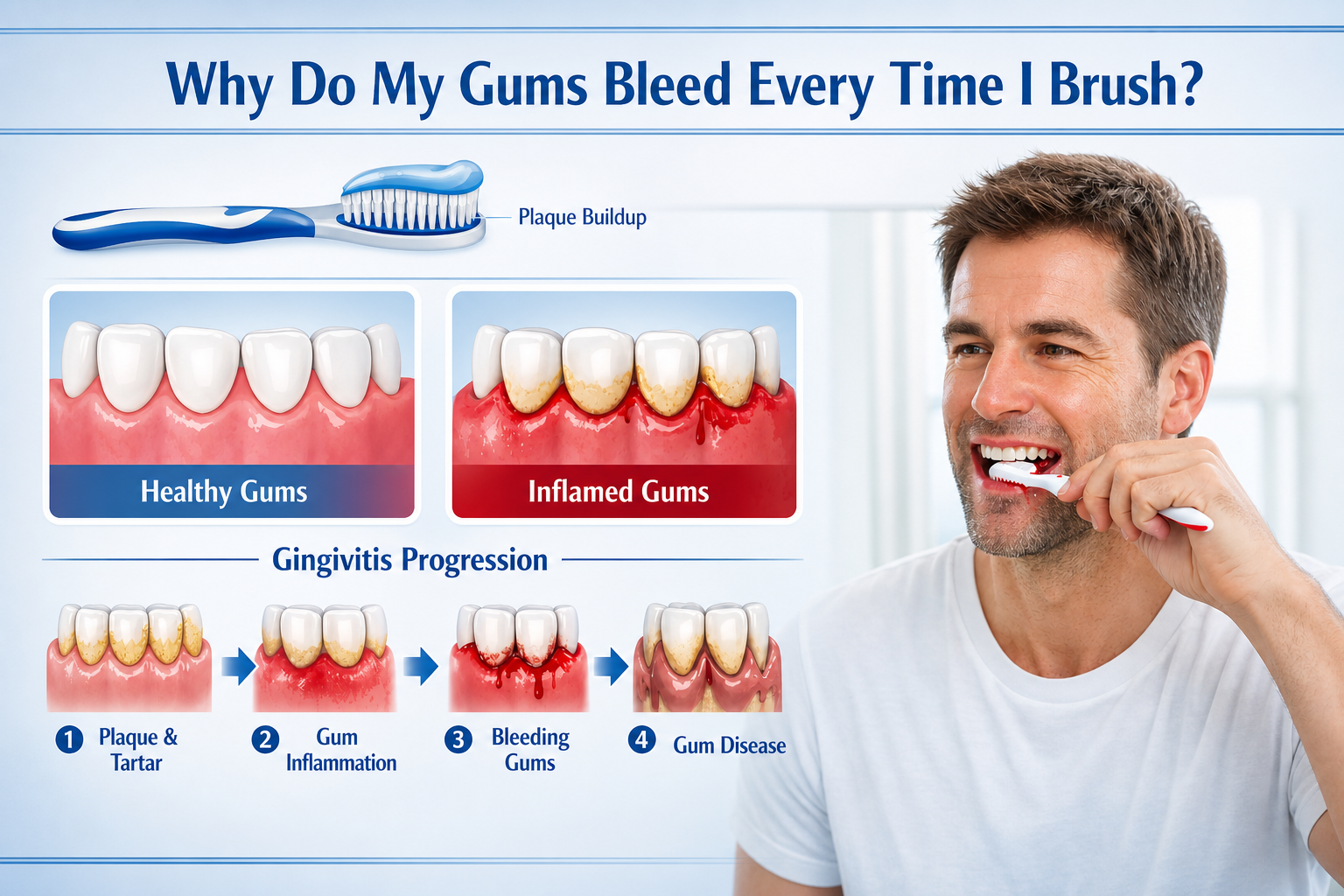
If your gums bleed every time you brush, the most likely cause is gingivitis — an early form of gum disease driven by plaque buildup along the gumline. Healthy gums do not bleed during normal brushing. Persistent bleeding is your body's inflammation signal that something needs attention.
Bleeding gums are far more common than most people realise, yet they are frequently dismissed as a minor inconvenience. According to a large multicenter study published via PubMed Central, the overall prevalence of self-reported gingival bleeding was 63.2%, with 58.7% of participants reporting bleeding specifically after toothbrushing. Despite how widespread this problem is, clinical evidence is clear: bleeding gums are not a normal part of brushing — they are a warning sign.
The good news is that when caught early, the underlying cause is almost always reversible. But left unaddressed, gum disease can progress into periodontitis, a condition that causes irreversible damage to the gum tissue, periodontal ligaments, and the jawbone that anchors your teeth. Understanding exactly why your gums bleed — and what drives that bleeding at a biological level — is the first step toward stopping it. The National Institute of Dental and Craniofacial Research confirms that gum disease affects nearly half of adults over 30 in the United States, making it one of the most prevalent chronic conditions in the country.
Why Do My Gums Bleed Every Time I Brush? The Biological Explanation
Gum bleeding during brushing is almost always rooted in inflammation. When plaque — a soft, sticky biofilm composed of bacteria, mucus, and food debris — accumulates along and beneath the gumline, the immune system responds by increasing blood flow to the area and triggering an inflammatory cascade linked to broader immune response dysregulation. This is known as gingival inflammation, or gingivitis. The inflamed tissue becomes engorged with blood, swells, and loses its normal tight attachment to the tooth surface. Even the mild mechanical pressure of a toothbrush bristle is then enough to rupture the fragile capillaries just beneath the surface epithelium, producing the bleeding most people associate with brushing.
A large diagnostic accuracy study published in 2021 by Needleman et al. assessed 2,853 participants and found that self-reported gingival bleeding achieved a sensitivity of 0.73 and a specificity of 0.89 for predicting clinically confirmed gingival inflammation — defined as bleeding on probing at 30% or more of sites. This means that when patients report bleeding gums, it is a highly reliable clinical indicator that genuine tissue inflammation is present, not simply a product of aggressive technique.
Key Point: Bleeding gums signal active gingival inflammation. The bleeding itself is not the disease — it is the immune system's vascular response to bacterial irritation at the gumline.
Gingivitis and Plaque: The Most Common Cause of Bleeding Gums
Gingivitis is, by a significant margin, the number one reason gums bleed during brushing. It develops when plaque is not consistently removed through daily brushing and flossing. Within as little as 24 to 72 hours, undisturbed plaque begins to mineralise into a hard deposit called tartar, or calculus, which adheres firmly to the tooth surface and cannot be removed by brushing alone. Tartar acts as a persistent reservoir of bacteria directly at the gumline, sustaining chronic low-grade inflammation.
The bacteria within the plaque biofilm — much like the disrupted gut microbiome implicated in systemic inflammation — particularly gram-negative anaerobes such as Porphyromonas gingivalis, Treponema denticola, and Tannerella forsythia — release lipopolysaccharides (LPS) and proteolytic enzymes that directly damage gingival tissue and activate host inflammatory mediators including interleukin-1β (IL-1β), tumour necrosis factor-alpha (TNF-α), and prostaglandin E2. These mediators increase vascular permeability and promote the tissue fragility that results in visible bleeding.
"Gingivitis is the most prevalent periodontal disease in children and adolescents... its high prevalence highlights a significant public health concern, especially in underserved populations, with rates ranging from 20% to over 90% across different countries."
— Frontiers in Oral Health, 2025 (PMID: 41312423)
Critically, gingivitis is entirely reversible. With thorough plaque removal and professional cleaning to eliminate tartar, gingival inflammation typically resolves within two to four weeks and bleeding ceases. However, if gingivitis is left untreated, it can progress to periodontitis — a destructive disease involving the irreversible breakdown of the alveolar bone and periodontal ligament that anchor teeth in place.
Other Causes of Bleeding Gums Beyond Gum Disease
While gingivitis accounts for the majority of cases, several other factors can independently cause or significantly worsen gingival bleeding. Recognising these contributors is important because addressing gum disease alone may not fully resolve the problem if an underlying systemic cause is present.
1
Aggressive Brushing Technique — Using a hard-bristled toothbrush or applying excessive pressure during brushing mechanically traumatises the delicate gingival epithelium. This causes direct tissue injury and abrasion independent of any underlying inflammation. The solution is switching to a soft-bristled toothbrush and using a gentle, small-circle or modified Bass technique.
2
Blood-Thinning Medications — Anticoagulants such as warfarin, heparin, and direct oral anticoagulants (DOACs) like rivaroxaban, as well as antiplatelet drugs including aspirin and clopidogrel, reduce the blood's ability to clot normally. This means even minor gingival trauma from brushing produces disproportionate bleeding that persists longer than expected.
3
Vitamin C Deficiency — Ascorbic acid is essential for collagen synthesis, the structural protein that forms the connective tissue of the gums. A deficiency in vitamin C impairs tissue repair, weakens capillary walls, and leads to a condition historically known as scurvy, the hallmark of which is spontaneous gingival bleeding. Even subclinical vitamin C deficiency can compromise gum integrity.
4
Vitamin K Deficiency — Vitamin K is a critical cofactor in the coagulation cascade, activating clotting factors II, VII, IX, and X through the gamma-carboxylation pathway. Insufficient vitamin K impairs the blood's ability to form stable clots, resulting in prolonged gingival bleeding after even light brushing.
5
Pregnancy-Associated Gingivitis — Elevated levels of progesterone and oestrogen during pregnancy increase gingival vascularity and alter the immune response to plaque bacteria, making pregnant women disproportionately susceptible to gingival inflammation. Research indicates that approximately 75% of pregnant women develop gingivitis, making pregnancy gingivitis one of the most common oral conditions during gestation.
6
Tobacco Use — Smoking and tobacco use impair local immune defences, reduce gingival blood flow, and suppress the normal inflammatory response. Counterintuitively, this means active smokers may show less visible bleeding even while harbouring significant underlying periodontal destruction — masking the severity of gum disease and delaying diagnosis.
7
Diabetes Mellitus — Poorly controlled blood sugar compromises immune cell function and impairs tissue healing through advanced glycation end-products (AGEs) that damage collagen and blood vessel walls. Individuals with diabetes are two to three times more likely to develop periodontitis, and gingival bleeding is often one of the earliest oral manifestations of inadequate glycaemic control.
When Bleeding Gums Signal Something More Serious
Bleeding gums are the most recognisable symptom of gum disease, but in rare cases they can indicate more serious systemic conditions. Haematological disorders including leukaemia, thrombocytopenia (abnormally low platelet count), and haemophilia can all manifest with spontaneous or excessive gingival bleeding. If bleeding is severe, occurs without any brushing stimulus, or is accompanied by easy bruising, fatigue, or unexplained pallor, prompt medical evaluation is warranted.
Beyond acute systemic disease, there is now robust evidence linking chronic periodontal inflammation to cardiovascular disease. In periodontal disease, persistent bacterial infection induces sustained local gingival inflammation that spills into systemic circulation, contributing to endothelial dysfunction and atherosclerosis through elevated circulating inflammatory markers. A 2021 systematic review and meta-analysis found that individuals with chronic periodontal disease had an average increase in C-reactive protein (CRP) levels of 103% compared to healthy controls — a clinically meaningful elevation that corresponds to significantly increased cardiovascular risk.
Important
Periodontal inflammation does not stay local. Chronic gum disease is independently associated with increased risk of heart disease, stroke, and type 2 diabetes through systemic inflammatory pathways. Treating gum disease is not purely a dental concern — it is a whole-body health priority.
How to Stop Gums Bleeding When Brushing: Evidence-Based Steps
The primary treatment for bleeding gums is thorough, consistent mechanical plaque removal combined with professional dental care. There is no supplement or mouthwash that will resolve gingival inflammation if the underlying plaque accumulation is not addressed. The following steps represent the clinical standard of care for reversing gingivitis and stopping recurrent bleeding.
1
Switch to a Soft-Bristled Toothbrush — Soft bristles are clinically equivalent in plaque removal to medium or firm bristles when used correctly, and they cause significantly less gingival trauma. An electric toothbrush with a pressure sensor can further reduce the risk of overbrushing.
2
Brush Twice Daily for Two Minutes — Use a small-circle or 45-degree angle technique targeting the gumline. Consistent twice-daily brushing is the single most impactful habit for plaque control and gingivitis prevention.
3
Floss or Use Interdental Brushes Daily — Approximately 40% of tooth surfaces are inaccessible to a toothbrush. Daily interdental cleaning removes the plaque accumulation between teeth that most commonly drives gingival inflammation at the interproximal sites.
4
Book a Professional Scale and Clean — Only a dental hygienist or dentist can remove hardened tartar (calculus) from the tooth surface. A professional clean removes the primary irritant sustaining chronic gingival inflammation. For many patients with early gingivitis, a single scale and clean combined with improved home care is enough to eliminate bleeding.
5
Address Nutritional Deficiencies — Ensuring adequate intake of vitamin C (75–90 mg/day for adults) and vitamin K through diet or supplementation supports gingival tissue integrity and normal clotting. Foods rich in vitamin C include citrus fruit, kiwi, and bell peppers; leafy green vegetables are a primary dietary source of vitamin K.
6
Quit Tobacco — Smoking cessation markedly improves gingival blood flow, restores normal immune defence at the gumline, and significantly reduces the risk of disease progression to periodontitis. Patients who quit smoking typically see measurable improvements in gingival health within weeks.
According to the Centers for Disease Control and Prevention, regular dental visits combined with daily home oral hygiene practices remain the most effective strategy for preventing and reversing gum disease. If bleeding persists after four weeks of improved oral hygiene, professional assessment is recommended to rule out periodontitis or a systemic contributing factor.
When Should You See a Dentist About Bleeding Gums?
Many people delay seeking dental care because they assume bleeding gums are normal or will resolve on their own. This delay is clinically significant because the window for reversing gingivitis before it becomes periodontitis is finite. Anyone who experiences gums that bleed every time they brush should schedule a dental examination if the bleeding does not improve within two to four weeks of optimised brushing and flossing technique.
Immediate dental or medical assessment is warranted in the following scenarios: bleeding that occurs without any brushing stimulus, swollen or severely tender gum tissue, gums that have visibly receded from the tooth surface, teeth that feel loose, persistent bad breath that does not resolve with brushing, or bleeding accompanied by systemic symptoms such as fatigue, unexplained weight loss, or easy bruising elsewhere on the body. These presentations suggest either advanced periodontitis or an underlying systemic condition that requires investigation beyond routine dental care.
Remember: Gingivitis is reversible. Periodontitis is not. Every week of delay in treating active gum inflammation represents further risk of irreversible bone and tissue loss. Early intervention is always the better clinical choice.
Frequently Asked Questions
Is it normal for gums to bleed every time I brush?
No. Healthy gums do not bleed during normal brushing. Recurrent bleeding is almost always a sign of gingival inflammation caused by plaque buildup, and it should be assessed by a dentist — particularly if it has been happening for more than two to four weeks.
Can bleeding gums go away on their own?
In cases of early gingivitis, yes — improved brushing and flossing technique can resolve gingival inflammation and stop bleeding within two to four weeks. However, if tartar has built up on the teeth, professional cleaning is required before home care alone can be fully effective. Bleeding caused by periodontitis, systemic disease, or medications will not resolve without targeted treatment.
Why do my gums bleed even though I brush twice a day?
Brushing frequency alone does not guarantee plaque control. Bleeding can persist despite twice-daily brushing if technique is poor, if interdental areas are not being cleaned with floss or interdental brushes, if hardened tartar is present (which cannot be removed by brushing), or if a contributing factor such as a vitamin deficiency, medication, or systemic condition is involved.
Can vitamin deficiency cause gums to bleed?
Yes. Vitamin C is essential for collagen synthesis and the structural integrity of gum tissue. Deficiency weakens capillary walls and impairs tissue repair, leading to gingival bleeding. Vitamin K is required for the activation of key clotting factors in the coagulation cascade; inadequate levels impair normal blood clotting and can cause prolonged gingival bleeding. Both deficiencies are underrecognised contributors to this problem.
Is bleeding gums linked to heart disease?
There is strong epidemiological and mechanistic evidence linking chronic periodontal disease to cardiovascular disease. Persistent gingival infection drives systemic inflammation — measurable through elevated C-reactive protein (CRP) — that contributes to endothelial dysfunction and atherosclerosis. A 2021 meta-analysis found that individuals with chronic periodontitis had CRP levels averaging 103% higher than healthy controls, a clinically significant elevation associated with increased cardiovascular risk.
Should I stop brushing if my gums are bleeding?
No — stopping brushing will worsen the underlying inflammation. Plaque will continue to accumulate undisturbed, deepening the inflammatory response and increasing bleeding. The correct approach is to continue brushing gently with a soft-bristled toothbrush, improve technique, and add daily flossing. Consistent plaque removal is the most important step in reversing gingivitis and stopping recurrent bleeding.
Can supplements help with bleeding gums?
Supplements that address nutritional gaps can support gum health when a deficiency is a contributing factor. Vitamin C supplements support collagen production and gingival tissue repair, while vitamin K supplements support normal clotting function. Coenzyme Q10 and certain probiotic strains have also been studied for their anti-inflammatory effects on gingival tissue. However, supplements should complement — never replace — good oral hygiene, a balanced diet, and professional dental care. Always discuss supplementation with a healthcare provider, especially if taking medications such as blood thinners.
Scientific References
1
Needleman I et al. "Have you had bleeding from your gums? Self-report to identify gingival inflammation (The SING diagnostic accuracy and diagnostic model development study)." Journal of Clinical Periodontology, 2021.
View on PubMed →
2
Frontiers in Oral Health Editorial Group. "Gingivitis in children and adolescents: epidemiological overview and associated factors — A narrative review." Frontiers in Oral Health, 2025.
View on PubMed →
3
Bourgeois D et al. "Prevalence and Associated Factors of Self-Reported Gingival Bleeding: A Multicenter Study in France." International Journal of Environmental Research and Public Health, 2020.
View on PMC →
4
Herrera D et al. "The Systemic Link Between Oral Health and Cardiovascular Disease: Contemporary Evidence, Mechanisms, and Risk Factor Implications." PMC/NIH, 2025.
View on PMC →
Sarah Mitchell writes educational content covering health, nutrition, and wellness topics. Her work is intended to present information in a clear and accessible format while encouraging readers to consult qualified healthcare professionals for personal medical advice.
Clinically Verified Ingredients12+ Years Nutrition ExperienceZero Brand DealsHuman-Reviewed
Disclaimer: The information on this site is intended for educational purposes only and does not constitute medical advice — always consult a qualified healthcare professional before starting any supplement regimen.