What Causes Stiff Joints in Morning RA

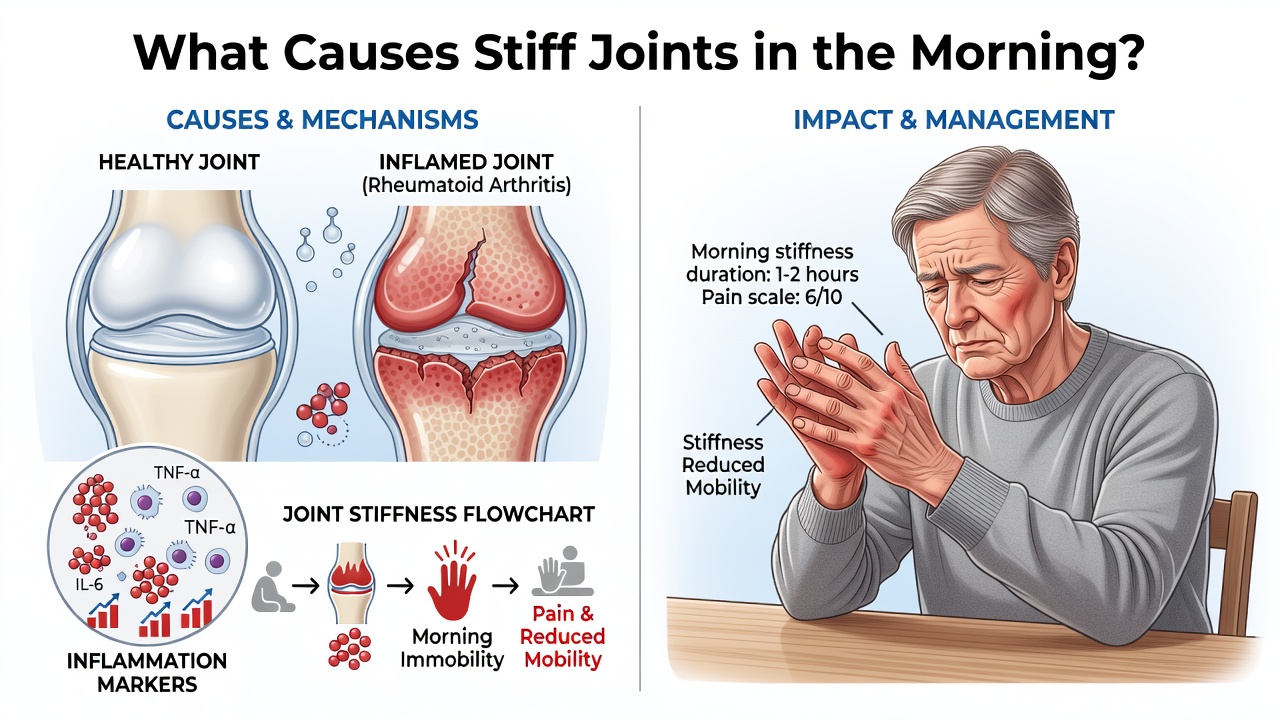
Morning joint stiffness lasting at least one hour is one of the most recognisable hallmarks of rheumatoid arthritis (RA). For millions of people worldwide, those first moments after waking are the most painful and limiting of the entire day. But what causes stiff joints in morning rheumatoid arthritis, and why does the problem peak specifically after sleep? The answer involves a precise interplay of inflammatory cytokines, synovial fluid dynamics, circadian hormone rhythms, and immune cell activity that collectively converge in the early hours of the morning. Understanding this biology not only validates the experience of RA patients but also points directly toward more targeted treatment strategies.
This article examines the leading scientific explanations for morning stiffness in RA, exploring each mechanism in clinically meaningful detail so that patients, caregivers, and healthcare practitioners can make better-informed decisions about symptom management and treatment timing.
What Morning Stiffness Actually Means in Rheumatoid Arthritis
Morning stiffness in RA is not simply muscle tightness from inactivity. It is a clinical feature so characteristic that the American College of Rheumatology historically used stiffness lasting more than one hour as a diagnostic criterion for RA. Unlike the brief stiffness of osteoarthritis, which typically resolves within thirty minutes, RA-related morning stiffness can persist for two to four hours or longer in active disease. It predominantly affects the small joints of the hands and feet, wrists, knees, and ankles, producing a gelling sensation that forces patients to move slowly and carefully upon waking.
The duration of morning stiffness correlates meaningfully with overall disease activity. Research published in Arthritis Care and Research confirmed that stiffness duration serves as a reliable patient-reported outcome measure and tracks closely with inflammatory markers such as C-reactive protein (CRP) and erythrocyte sedimentation rate (ESR). In other words, longer morning stiffness signals more active inflammation — it is not a secondary inconvenience but a direct expression of ongoing synovial disease.
Synovial Inflammation: The Central Driver
The joint lining in RA — the synovium — becomes chronically inflamed and thickened in a process called synovitis. In a healthy joint, the synovium is a thin membrane a few cells thick that secretes lubricating synovial fluid. In RA, an autoimmune attack causes the synovium to proliferate abnormally, forming a destructive tissue mass called pannus. Immune cells — particularly T lymphocytes, B lymphocytes, macrophages, and mast cells — infiltrate this thickened synovium and release a cascade of pro-inflammatory mediators.
During sleep, the joint is held largely still and in a partially flexed position. Fluid and inflammatory exudate accumulate within the joint capsule without the mechanical pumping action that movement provides. By morning, the joint is engorged with inflammatory fluid rich in cytokines, prostaglandins, and immune complexes. Moving the joint requires overcoming the resistance of this swollen, thickened tissue — producing the characteristic gelling and stiffness. A study in Annals of the Rheumatic Diseases documented how synovial tissue oedema and cellular infiltration peak during overnight rest, providing direct histological evidence for why morning symptoms are most severe.
Cytokines and the Circadian Rhythm of Inflammation
Perhaps the most compelling explanation for morning stiffness lies in the circadian biology of inflammatory cytokines. Key pro-inflammatory molecules including interleukin-6 (IL-6), tumour necrosis factor-alpha (TNF-α), and interleukin-1 beta (IL-1β) follow distinct circadian rhythms in RA patients, with plasma concentrations peaking during the night and early morning hours — precisely when stiffness is at its worst.
IL-6, one of the most important drivers of systemic inflammation in RA, demonstrates a nocturnal surge. Concentrations begin rising in the late evening, peak between approximately 2 and 7 a.m., and decline through the day. This timing aligns almost perfectly with the clinical experience of morning stiffness. A landmark study by Arvidson and colleagues demonstrated that peak IL-6 levels in RA patients preceded peak morning stiffness by approximately two to three hours, suggesting a direct causal relationship between cytokine surge and clinical symptoms.
TNF-α follows a similar pattern, with night-time elevations promoting synovial membrane permeability, immune cell recruitment, and cartilage-degrading enzyme production. The inflammatory environment that accumulates during these nocturnal hours translates into the stiff, swollen joints patients experience upon waking. This understanding has profoundly influenced treatment development — biologic therapies targeting IL-6 (tocilizumab) and TNF-α (etanercept, adalimumab) are among the most effective interventions for reducing morning stiffness in RA.
The Cortisol-Inflammation Paradox: HPA Axis Dysfunction
Cortisol is the body's most potent endogenous anti-inflammatory hormone. Under normal physiological conditions, cortisol follows a diurnal rhythm: levels are lowest in the early-to-mid night hours and rise sharply in the early morning — a process called the cortisol awakening response — reaching peak concentrations around 8 to 9 a.m. This surge is designed to prepare the body for the physical and metabolic demands of the day, and in healthy individuals, it simultaneously suppresses the inflammatory activity that accumulates during sleep.
In RA, this protective mechanism is impaired. Research has demonstrated that RA patients exhibit a blunted cortisol awakening response and relative adrenal insufficiency in the context of their inflammatory burden. The hypothalamic-pituitary-adrenal (HPA) axis fails to produce sufficient cortisol to counter the intense cytokine surge occurring in the early morning hours. A study in the Journal of Rheumatology confirmed that RA patients have inappropriately low cortisol levels relative to their degree of inflammation, meaning the natural brake on inflammation is simply not strong enough to prevent morning symptoms.
This is the physiological rationale behind low-dose, night-time modified-release prednisone formulations such as Lodotra. Clinical trials demonstrated that taking glucocorticoids at 10 p.m. — timed to release in the early morning hours — reduced morning stiffness duration significantly compared with standard morning dosing, directly supporting the HPA-axis hypothesis. For more information on how systemic inflammation affects the body, the National Institute of Arthritis and Musculoskeletal and Skin Diseases (NIAMS) provides authoritative patient resources on rheumatoid arthritis management.
Synovial Fluid Changes During Inactivity
Synovial fluid serves as both lubricant and nutrient medium for articular cartilage. Its rheological properties — particularly its viscosity — depend on hyaluronic acid concentration and the mechanical action of joint movement. During sleep, with joints held relatively immobile for six to eight hours, synovial fluid becomes less evenly distributed across the joint surface. In an inflamed joint, the fluid composition is further altered: elevated concentrations of proteases, inflammatory cytokines, and degradation products reduce the quality and protective function of the fluid.
This produces what clinicians describe as the "gel phenomenon." Just as a gel stiffens when left undisturbed, the poorly circulated, cytokine-laden synovial fluid thickens the effective mechanical resistance within the joint. The first movements of the morning are therefore the most difficult, as the fluid must be redistributed and warmed before joint mechanics normalise. Research in Seminars in Arthritis and Rheumatism characterised these viscoelastic changes in RA synovial fluid and their relationship to functional impairment, confirming that inflammatory fluid composition directly worsens morning mechanical performance.
Nocturnal Immune Cell Activity and Mast Cell Degranulation
The immune system is not quiescent during sleep. In fact, several critical immune processes peak during nighttime hours as part of normal immunological memory consolidation and repair. In RA, disruptions in the gut microbiome further exacerbate this nocturnal immune activity becomes destructive rather than restorative. T helper cells, macrophages, and mast cells within the synovium are particularly active during sleep, driven partly by rising cytokine concentrations and partly by the reduced physical activity that allows immune cell accumulation in joint tissues.
Mast cells within the RA synovium deserve particular attention. These tissue-resident immune cells release histamine, prostaglandins, and proteases upon degranulation, all of which increase local oedema and sensitise nociceptors — the pain-detecting nerve endings within joint capsules. Mast cell degranulation in synovial tissue follows a circadian pattern influenced by the autonomic nervous system, with peak activity correlating with the early morning inflammatory surge. Studies investigating mast cell biology in RA have confirmed their role as amplifiers of synovial inflammation, adding another layer to the mechanistic explanation for morning stiffness.
Furthermore, sympathetic nervous system activity — which normally suppresses immune function — is lowest during sleep. This relative reduction in sympathetic tone removes an inhibitory signal from immune cells, permitting more vigorous inflammatory activity during the night. As sympathetic activity rises with waking, it begins to dampen immune activation, which partly explains why stiffness gradually improves as the morning progresses.
Clinical Approaches to Reducing Morning Stiffness
Understanding the biological mechanisms behind morning stiffness directly informs management strategies. Nutritional support such as GoldAlign may complement these approaches. The goal is to interrupt as many contributing pathways as possible, both through disease-modifying treatments and supportive lifestyle measures.
Disease-modifying antirheumatic drugs (DMARDs) remain the cornerstone of RA treatment. Supporting immune function may complement these treatments. Methotrexate, the most widely used conventional DMARD, reduces overall inflammatory burden and consequently shortens morning stiffness duration. Biologic DMARDs targeting IL-6 and TNF-α have shown particular efficacy in reducing morning stiffness because they directly suppress the cytokines responsible for the nocturnal inflammatory surge.
Chronotherapy with glucocorticoids represents a targeted approach to the cortisol-inflammation mismatch. Modified-release prednisone taken at bedtime delivers its anti-inflammatory effect during the early morning cytokine peak, reducing stiffness duration more effectively than conventional morning dosing. A pivotal randomised controlled trial published in Annals of the Rheumatic Diseases demonstrated a 22.7% reduction in morning stiffness duration with night-time modified-release prednisone compared with conventional morning dosing.
Gentle morning movement is consistently recommended by rheumatologists. Warm showers or baths upon waking help redistribute synovial fluid, raise joint temperature, and reduce viscosity. Range-of-motion exercises performed within warmth can significantly shorten the duration of functional limitation. Sleeping with joint-supporting positioning aids can also reduce the degree of fluid accumulation during the night.
Omega-3 fatty acids from fish oil have demonstrated modest but clinically meaningful reductions in morning stiffness duration in RA. A meta-analysis in Epidemiology and subsequent trials confirmed that omega-3 supplementation reduces inflammatory cytokine production, including IL-1β and TNF-α, offering a supportive nutritional strategy alongside pharmaceutical management.
When Morning Stiffness Signals Inadequate Disease Control
Persistent morning stiffness lasting more than 45 minutes is a reliable indicator that RA disease activity is not well controlled. Patients experiencing prolonged stiffness despite current treatment should discuss this with their rheumatologist, as it may indicate the need to adjust DMARD therapy, add a biologic agent, or reassess steroid dosing strategies. Tracking stiffness duration each morning in a symptom diary provides useful objective data for clinical appointments and helps guide treatment escalation decisions.
It is also important to distinguish RA morning stiffness from that caused by other conditions. Polymyalgia rheumatica, psoriatic arthritis, and ankylosing spondylitis can all produce prolonged morning stiffness and require different treatment approaches. A thorough rheumatological evaluation including inflammatory markers, autoantibody testing, and imaging provides the diagnostic clarity needed to ensure appropriate management.
Frequently Asked Questions
Scientific References
Editorial Information
Sarah Mitchell writes educational content covering health, nutrition, and wellness topics. Her work is intended to present information in a clear and accessible format while encouraging readers to consult qualified healthcare professionals for personal medical advice.